On 7–8 November 2026 the Taipei City Government's Department of Information Technology held the 2026 Taipei Autumn Codefest – City Pass Microservice Hackathon at the Tianmu Campus gymnasium of the University of Taipei. 85 teams and 395 people applied; after a document review, a pre-event workshop and team interviews, 40 teams competed, each building a city-service microservice for the Taipei Pass (台北通) app over two days and one night. PeakQi's team, entered as "AI城市起風", won an Honorable Mention with "用得了" (roughly, "Usable after all"). It is the same team's second government-hackathon award, after the New Taipei AI Smart City Hackathon in September. This report covers the competition, the brief we drew, and what 用得了 does.
The competition
The autumn Codefest uses Taipei Pass as its platform: teams build new microservices on top of the open-source City Pass framework. This year's theme was digital equity and inclusion, and the department's press release framed it around three ways residents get stuck with digital services: they can't use them, can't understand them, or can't get what they need.
- Name: 2026 Taipei Autumn Codefest – City Pass Microservice Hackathon
- Organiser: Department of Information Technology, Taipei City Government
- Date and venue: 7–8 November 2026, Tianmu Campus gymnasium, University of Taipei
- Scale: 85 teams and 395 applicants; 40 teams admitted to the competition
- Awards: one first, second and third place, plus three Honorable Mentions; prizes of NT$300,000, NT$150,000 and NT$100,000, and NT$50,000 for each Honorable Mention — NT$700,000 in total
- Results: first place to 尖銳吉吉如綠豆冰 for "台北一點就通!", a microservice-entry assistant; second to 威靈頓牛排 for "Polaris 台北通小幫手"; third to 報報王 for "好行How Go?", indoor and outdoor accessible navigation. Honorable Mentions went to 得獎的是!?, 全員被電組 and AI城市起風.
The rules were strict. Only open-source software and packages were allowed, and entries are released under the AGPL. Core data had to come from public, lawful open data. Any feature using a large language model for real-time inference had to run that inference entirely on the device — no cloud model APIs. Presentations ran about 2 minutes in the first round and 5 minutes in the final, and teams could only project their working product: no slide decks.

The team: AI城市起風
AI城市起風 is four PeakQi members: Jacky Wu (founder and CEO; team lead and planning), Chuang Po-chin (UI/UX design), Allen Hong (COO and head of AI products; front end) and Ting Chia-chi (CTO; back end). PeakQi was founded in 2024 and focuses on AI adoption for small and mid-sized businesses — scoping the need, building the system and iterating after launch — with 30-plus systems delivered. More on the team on our About page.
The brief: "Can't use it"
Briefs were revealed on the day. We drew "01 Can't use it" (用不了): people shut out of digital services by physical limitations — people with disabilities, older adults, pregnant women, the sick or injured, and caregivers.
We started from the numbers. According to the Ministry of Health and Welfare, as of June 2026, 76.3% of people registered with hearing impairments and 59.4% with visual impairments in Taiwan are 65 or older; the Taipei City Department of Budget, Accounting and Statistics reports that 23.9% of Taipei's population was 65 or older at the end of September 2025. In other words, most blind and deaf users are also older adults. So rather than building a separate service for each group, we built one entry point with modes.
The other observation: city services are organised by agency, so an older resident first has to know which department handles their problem. And many services are phone-only, which shuts out deaf users.
What we built: 用得了
用得了's tagline is "Usable, even when things aren't easy." It lives inside Taipei Pass, designed for older adults and for people with mobility, vision or hearing difficulties — and it helps during pregnancy, after an injury, or when accompanying a family member. Internally we called it "elder mode".
On first launch you pick a mode, and you can switch at any time. Modes change how the service behaves, never what it offers:
| Default | Low vision | Hard of hearing | |
|---|---|---|---|
| Pressing a button | Vibration, large text, spoken label | Same | Vibration and large text, no sound |
| Text size | Follows the phone | At least 1.3× larger | Follows the phone |
| Finding a service | Speak or type | Speak or type | Type only |
| 1999 hotline on home screen | Dials directly | Dials directly | Becomes "1999 by text" |
| Phone vs text channels | Phone first | Phone first | Text first; phone-only services say so and offer an alternative |
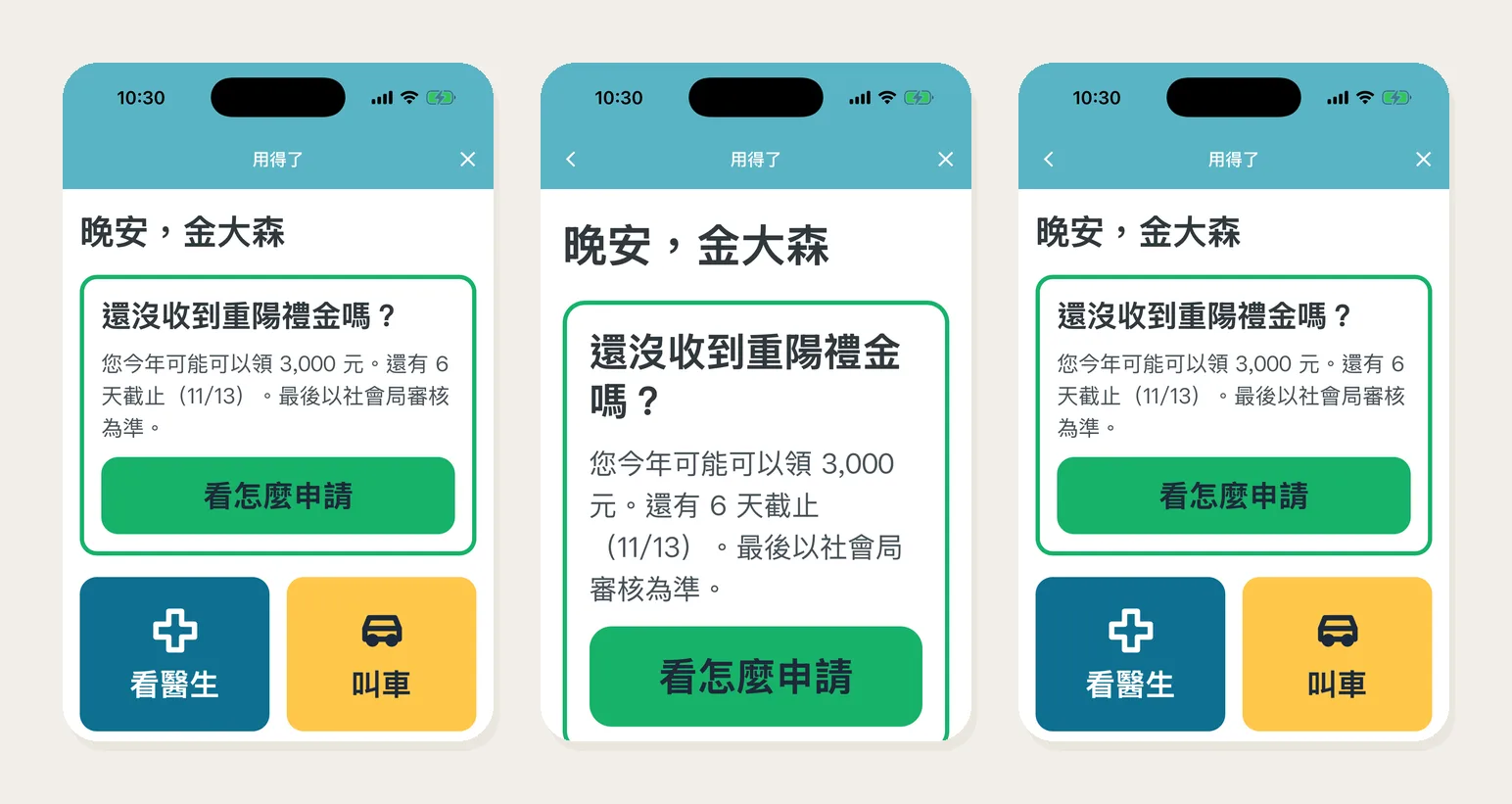
The home screen holds only four to six large buttons, chosen by family members; everything else is found by speaking or typing. The service has 17 modules in total, including:
- Say it to find it: "I need to see a doctor" brings up hospital booking, ride options and the 1966 long-term-care line together — organised by need, not by agency.
- Doctor visits and a clinic communication card: users who can't hear well tick their symptoms and show a full-screen card to staff; a phone notification fires the evening before a follow-up visit or prescription pickup.
- Rides: at most two questions route the user to accessible transit, long-term-care transport or senior taxi subsidies, with a next option if booking fails.
- Family and emergencies: family members configure the home screen and contacts by QR code; the help page prepares 119 and 110 text-message templates that the user sends themselves.
- Benefits and subsidy helper: birthday and household registration surface eligible benefits; three questions narrow down subsidies worth applying for, with the documents needed.
- What's nearby: community meals and senior classes, accessible toilets, metro lifts, nursing rooms, AEDs and evacuation shelters.
- Scam check: type what the caller said and the phone matches it against common scam scripts; if nothing matches it says "not sure — stop for now", never "safe".
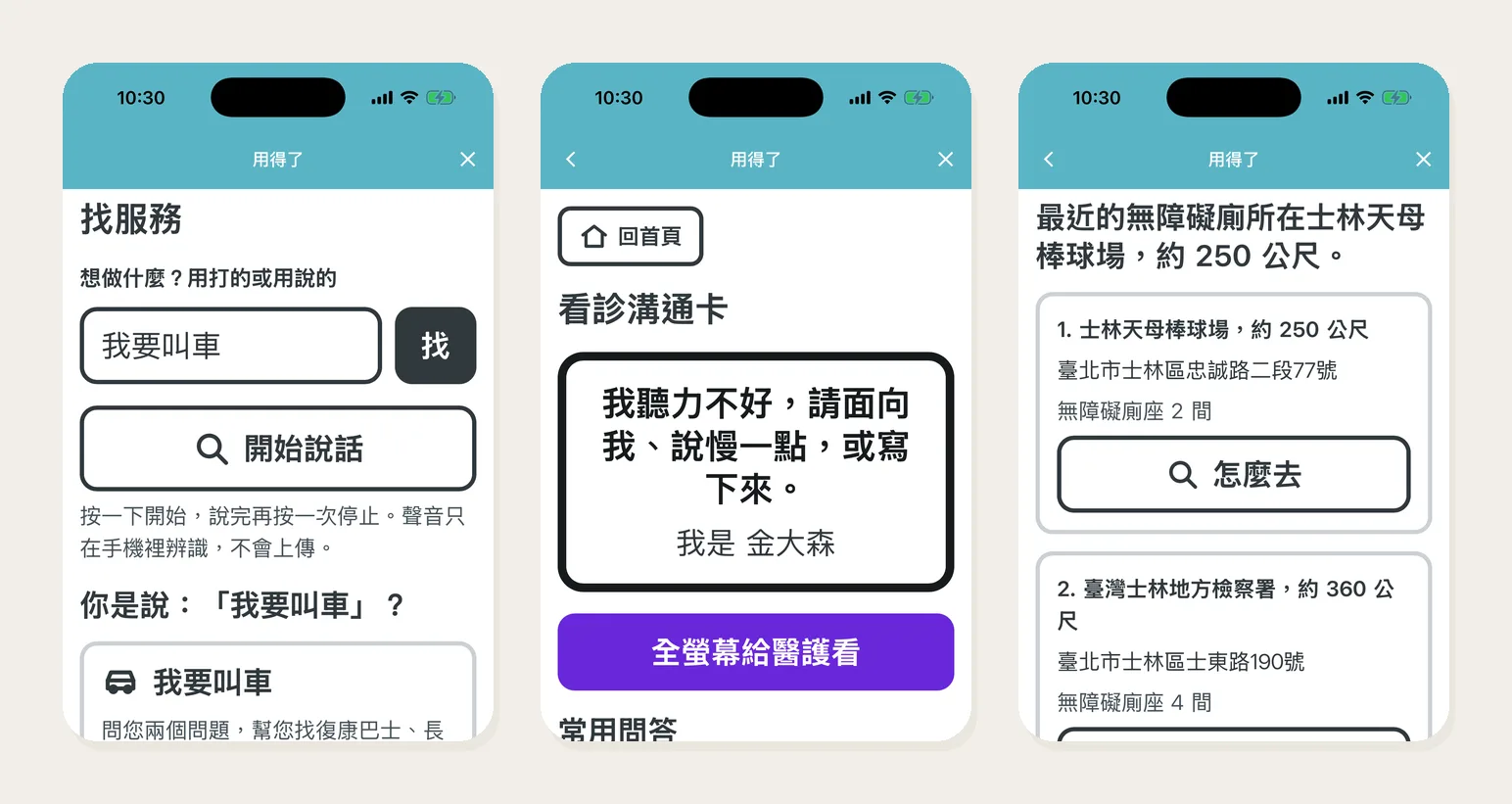
No cloud AI, and it works offline
Following the rules, speech recognition runs on the phone and audio is never uploaded; service search uses a bundled service list and phrase matching, so nothing calls a cloud AI at run time. Once the page is open, users can keep typing, searching, switching pages and showing the communication card even without a connection.
Data comes from Taipei's open-data platform, data.taipei — community meal sites, care points, metro accessibility facilities, audible traffic signals, toilets and nursing rooms, vaccination and screening clinics — with walking routes from OpenStreetMap. The source code is public under the AGPL on GitHub.
How this connects to PeakQi's everyday work
Two government hackathons in two months, with very different briefs: appraisal review in New Taipei, older adults on smartphones in Taipei. The method was the same: find out who uses it and where they get stuck, then decide where AI belongs and where it doesn't. With cloud AI off the table this time, the work went into flow design — few choices, a text route next to every phone route, and nothing that punishes a wrong tap.
Business AI adoption is no different. Staff and customers aren't always comfortable with new tools, so a system has to work for someone using it for the first time. See what we've delivered in our case studies and solutions; the appraisal review system the same team built is covered in our New Taipei AI Smart City Hackathon report.
Media coverage
- Taipei City Department of Information Technology press release (10 Nov 2026): "2026 Taipei Autumn Codefest" concludes (Chinese)
- yam News / Talknews: Taipei Autumn Codefest concludes, focused on digital equity and inclusion (Chinese)
- yam News / Talknews: 40 teams build a digitally friendly city (Chinese)
- yam News: Hackathon concludes, "台北一點就通" takes first place (Chinese)
- Liberty Times (pre-event): Registration opens, NT$700,000 total prize pool (Chinese)
- Official site: 2026 Taipei Autumn Codefest
Frequently asked questions
Q: Can I use 用得了 in Taipei Pass today? Not yet — it is a competition entry and has not been published in Taipei Pass. Under the competition rules, winning teams help integrate their work with the City Pass open-source code on the organiser's schedule; whether and when it ships is up to the Taipei City Department of Information Technology.
Q: Without cloud AI, how does it understand what people say? The phone's built-in speech recognition runs on the device, so audio never leaves it. The recognised text is matched against common phrasings in the service list, such as "I need to see a doctor" or "I'm pregnant and need a toilet". If the phone can't recognise speech offline, users can still type or browse by category.
Q: 17 modules in two days — how long does a real rollout take? The hackathon brief was tightly scoped and all the data was public open data. For business clients, standard modules can go live in as little as 10 working days; integrations with existing systems or custom rules are scoped separately — see our method.
Q: Does PeakQi only work on government projects? No. Most of our clients are small and mid-sized businesses, and we help them hand customer service, sales and admin workflows to AI. Government hackathons are where we test the same approach on public-service problems. If you'd like to talk about whether your workflow is a good fit for AI, let's find a time to talk.
By the PeakQi team. Competition details follow the Taipei City Department of Information Technology press release, the official Codefest site and the media coverage listed above; the product description reflects the version shown at the final on 8 November 2026; award photo courtesy of the Taipei City Department of Information Technology. Published 2026-11-14.