On 13 November 2026, the Taipei Computer Association (TCA) published the final results of the 2026 AI Rookie Selection (115年度 AI 新銳選拔) on the programme's official website. After a preliminary review and a final review, 39 proposals were awarded development grants. PeakQi (奇鋒國際有限公司) received the top-tier grant of NT$300,000 for "PeakQi AI Adoption Compiler: turn the processes in a business owner's head into AI employees that go live in 10 days, from a 30-minute interview" — one of 10 proposals in that tier. This report covers what the programme is, what we proposed, and the proof of concept we built with our partner company, GIGABYTE, ahead of the final review.
The programme
The AI Rookie Selection is a flagship annual project of Taiwan's Administration for Digital Industries (Ministry of Digital Affairs), run by the Taipei Computer Association. Its stated approach is "large companies lifting smaller ones": leading firms set out the problem areas they care about, and AI teams build solutions for them, so that the technology turns into products faster.
- Name: 2026 AI Rookie Selection (115年度 AI 新銳選拔)
- Run by: Taipei Computer Association (TCA)
- Partner companies: AMD, Cisco, LINE, Microsoft, NVIDIA, Tatung, Compal, GIGABYTE, LILIN, MiTAC, Galaxy Software Services, Openfind and Far EasTone — 13 in total
- Fields: Agentic AI, Edge AI, Physical AI, language models, cybersecurity, quantum computing
- Timeline: launched 9 July; preliminary results 31 August (43 proposals passed); exchanges with partner companies in September; final review meetings in October; final results 13 November
- Final review weighting: execution 40%, commercial viability and competitiveness 30%, completeness and administrative cooperation 30%
Final results were announced in three grant tiers:
| Development grant (NT$, tax included) | Proposals |
|---|---|
| 300,000 (maximum per proposal) | 10 |
| 200,000 | 18 |
| 100,000 | 11 |
| Total | 39 |
PeakQi's proposal was classified under "Agentic AI × Smart Commerce" in the preliminary round. The official list is on the AI Rookie Selection announcements page.
What we proposed: turning "AI adoption" itself into a product
Small businesses that want to use AI usually get stuck at step one: they don't know which part of their work AI should take over. Hiring a consultant to map it out is expensive, and what comes back is usually a report — someone still has to build a system from it.
The AI Adoption Compiler hands the consultant's job to AI, and makes sure the diagnosis doesn't end as a report:
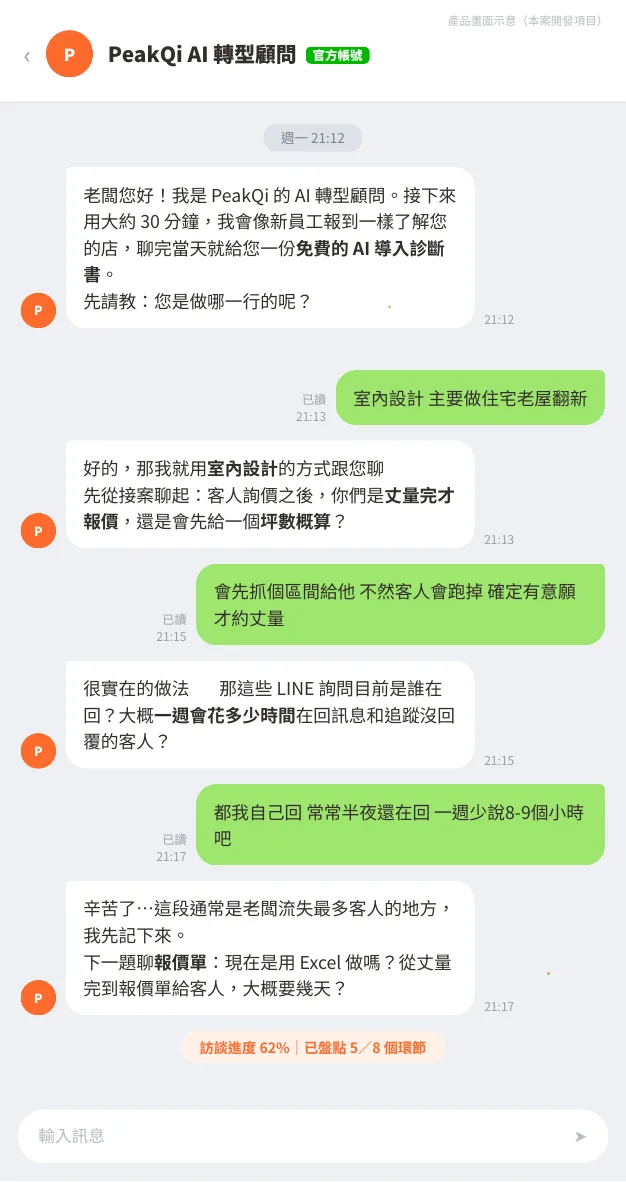
- 30-minute interview: the owner chats with an AI consultant on LINE. The AI loads the question set for that industry and asks follow-ups whenever information is missing.
- Same-day diagnosis: a map of current processes, ranked pain points and estimated benefits, with anything the AI is unsure about flagged.
- Human review: a consultant only handles the items flagged as uncertain or high-risk.
- Live in 10 days: the diagnosis is also output as a machine-readable deployment spec, which maps directly onto existing modules.
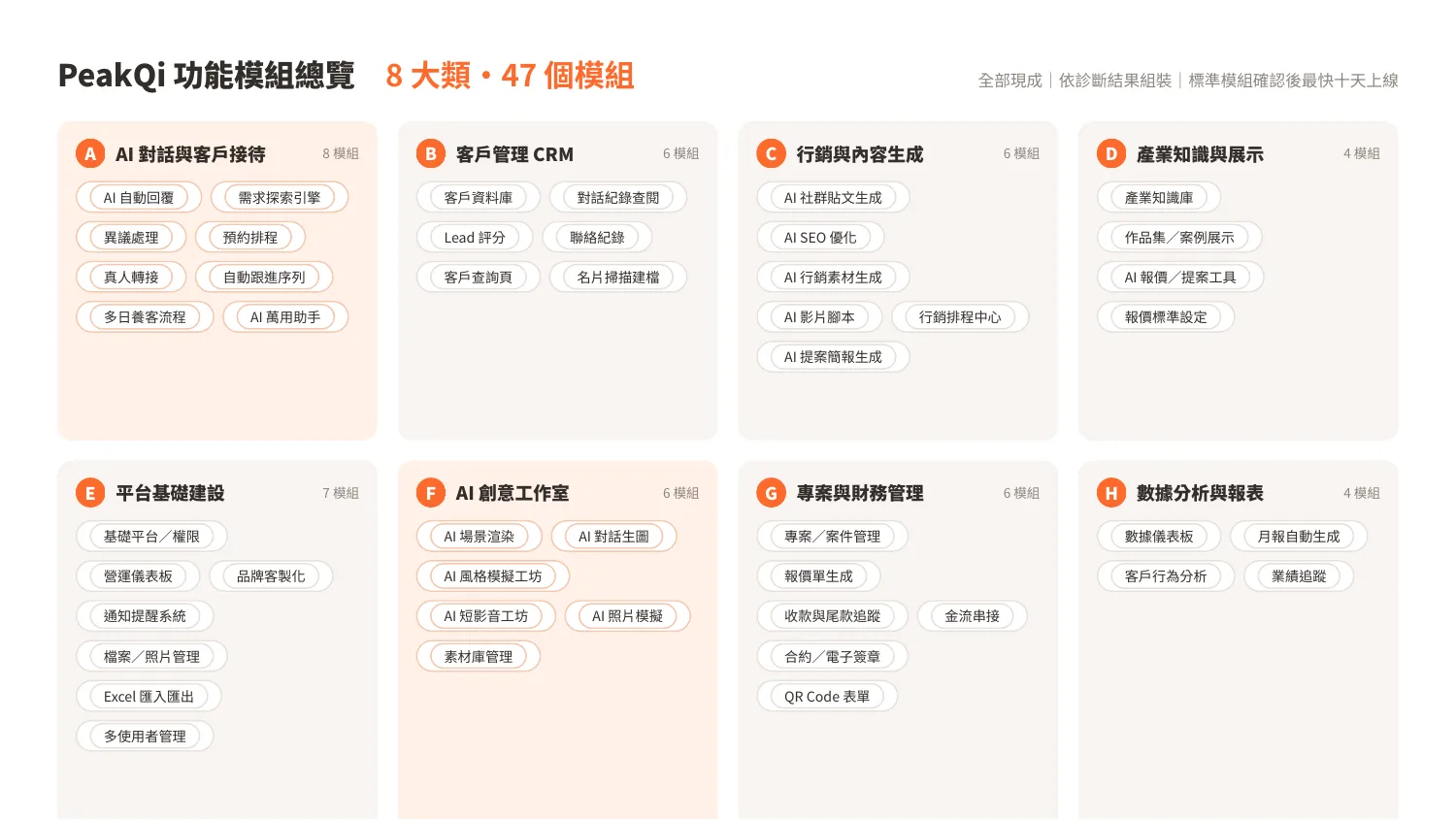
We call it a compiler because it does what a compiler does: it turns what people say — unstructured knowledge — into a spec a machine can execute. That works because of what PeakQi has built up through client projects: 47 functional modules in 8 categories, and three industry editions already live (weddings, interior design and marketing).
Proof of concept: PeakQi × GIGABYTE, testing the same engine on cybersecurity
After the preliminary round, teams were required to combine or deepen their original proposal with a partner company's brief. Our partner was GIGABYTE, and the brief was in cybersecurity: without a complete software bill of materials (SBOM), how do you tell which devices a vulnerability affects — and turn that judgement into a fix someone actually tracks?
That looks far from small-business AI adoption, but the core problem is the same: information is missing, and it has to be filled in before anyone can decide.
| Step | Original proposal: SME AI adoption | Proof of concept: manufacturer security |
|---|---|---|
| Fill the gaps | AI interviews the owner and asks about missing steps | Read-only, no-install scripts inventory real machines; what can't be found becomes a question card |
| Match and decide | Compare with standard industry processes to find what AI should take over | Compare with official advisories and vulnerability databases to decide if a device is affected |
| Human checkpoint | Low-confidence or high-risk items go to a human consultant | Low confidence, conflicting verdicts or known-exploited vulnerabilities go to a security reviewer |
| Two outputs | A diagnosis for people, a deployment spec for machines | A remediation report for people, CycloneDX SBOM and VEX for machines |
| Drive action | Assemble modules from the spec | Open remediation tickets automatically, escalate when overdue |
The compiler's input changes from "the owner's description of the work" to "machine inventory and supply-chain data"; the output changes from "a module deployment list" to "an SBOM and remediation tickets". The mechanism in the middle — every result carries evidence and a confidence score, and low confidence goes to a person — is unchanged. This was the fourth time the engine was moved to a new setting: the first three changed industry, this one changed the field of application.
How it works: an AI team with clear roles
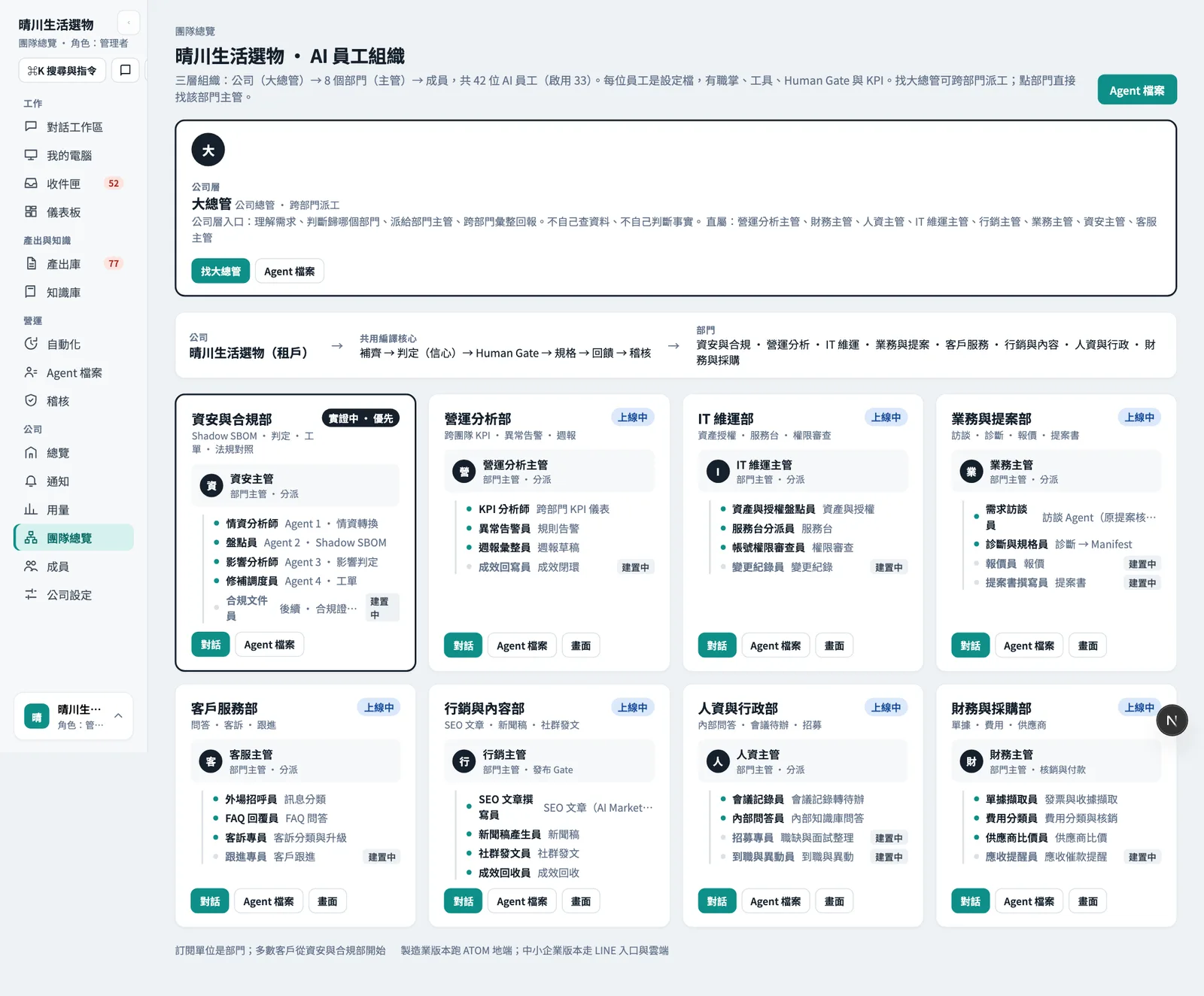
What we built is a multi-agent platform organised like a company. A company-level coordinator only decides which department a request belongs to and hands it over; department leads assign it to members; each member has its own responsibilities, permitted tools, human checkpoints and metrics.
The security and compliance department runs two pipelines that share one human review step:
- Vulnerability matching: a read-only inventory builds a "shadow SBOM" in which every component carries its source and a confidence score. Verdicts draw on evidence in a fixed order — official advisory, then database version ranges, then model inference. Confident verdicts open tickets automatically; the rest go to a review queue. Machine verdicts and human rulings are stored in separate fields and never overwrite each other, so accuracy can be recalculated at any time.
- Incident response: a security alert usually carries only an IP address. The system maps it to a device and a person through DHCP leases, subnets and the staff directory, with a confidence score, then opens an incident ticket and notifies the user; replies go straight into the ticket and overdue items escalate. The system only notifies and tracks — it never touches the endpoint.
The same core parts (inventory, verdict, review, confirmation cards, tickets, audit trail) were reused to stand up seven more departments: IT operations, customer service, sales and proposals, marketing and content, HR and admin, finance and procurement, and operations analytics. Each is demonstrated with sample data from a fictional company.
Results submitted for the final review
These figures come from the results report we submitted in October, which also documents how each one was measured:
| Metric | Result | Notes |
|---|---|---|
| Component mapping rate | 99.7% | 339 of 340 inventoried items on one real machine identified with sufficient confidence |
| Impact verdict F1 | 1.00 | 10 development cases; 3 held-out test cases run only after the version freeze |
| Tickets opened automatically | 86% | 12 of 14 |
| Verdicts needing human review | 3.2% | 10 of 315 |
| Time per vulnerability event | about 35 min → about 1.2 min | estimated baseline, including spot checks |
| Regulatory clauses mapped | 24 | NTIA minimum elements, EU CRA, ISO 27001, Taiwan's Cyber Security Management Act |
No model was fine-tuned in this phase. The approach combines prompt engineering, JSON-Schema-constrained output and a rules engine; thresholds were calibrated on the development set and then fixed.
The team
The proposal team was three PeakQi members: Jacky Wu (founder and CEO), Allen Hong (COO and head of AI products) and Ting Chia-chi (CTO). PeakQi was founded in 2024 and focuses on AI adoption for small and mid-sized businesses — from scoping the need and building the system to iterating after launch. More on our about page.
The team's Land Office track win at New Taipei's AI Smart City Hackathon in September rested on the same principles: numbers come from rules, every judgement cites its basis, and inferred values go to a person to confirm. Two different briefs, one idea being tested: AI judgements should be traceable, and people should only have to handle the exceptions.
How this connects to our everyday work
The AI Adoption Compiler grew out of client projects. When we help a business adopt AI, the slowest part is always the up-front mapping — the process lives in the owner's head, with no system record. Handing the interview, diagnosis and spec to AI, with people reviewing the exceptions, shortens that lead time and turns each project's lessons into modules the next one can reuse.
Our approach by industry is on the solutions page, and systems we've delivered are in case studies. The system isn't open for public demos yet; if you'd like to find out which of your processes suit AI, let's find a time to talk.
Frequently asked questions
Q: Who runs the AI Rookie Selection? It is a flagship annual project of the Administration for Digital Industries under the Ministry of Digital Affairs, run by the Taipei Computer Association, with 13 leading companies setting the problem areas.
Q: Which tier did PeakQi receive? The top tier: a development grant of NT$300,000 (tax included). Ten proposals received this tier, out of 39 that received grants in total.
Q: What does a cybersecurity brief have to do with SME AI adoption? Both come down to filling in missing information before deciding, with low-confidence cases going to a person. The security work moved the same engine to a new field to show it isn't tied to one scenario.
Q: Can we adopt this system now? It isn't open for public demos yet. If you want to know whether it fits your processes, book a conversation and we'll scope it with you.
By the PeakQi team. Programme details are as published on the official AI Rookie Selection website (information as of November 2026); system descriptions and figures are as stated in the final-review results report submitted in October 2026. Published 2026-11-14.