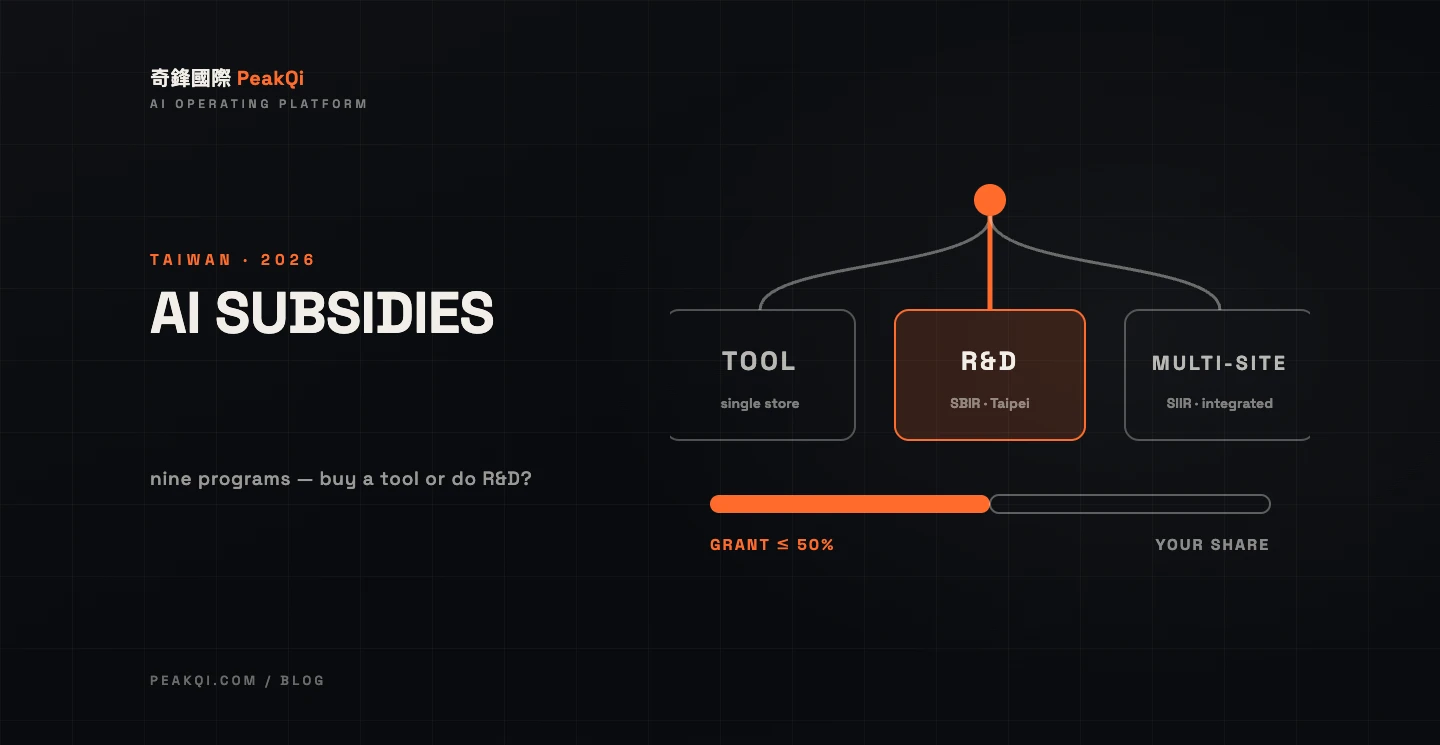
As of November 2026, four AI adoption subsidies are still open to small and medium-sized businesses in Taiwan: Taipei City's "AI Innovation Applications" thematic R&D grant (NT$2 million per project, applications close November 30), Taipei's general innovation R&D grant (up to NT$5 million, open year-round), the Ministry of Economic Affairs' SBIR program (Phase 1 up to NT$1.5 million, open year-round), and the single-store track of the Commerce Development Administration's Resilience Program (up to NT$100,000 per store, open until October 20, 2027 or until funds run out). The 2026 rounds of SIIR, the Resilience Program's integrated track and the manufacturing succession AI program have closed, so now is the time to prepare for 2027. To choose, start with one question: are you buying a ready-made tool, or doing your own R&D?
Taiwan's 2026 AI subsidies at a glance
The table below covers the main 2026 (ROC year 115) programs related to AI adoption and digital transformation. Figures come from official notices or program websites and are current as of November 2026. Programs change every year, so read the latest official guidelines before applying.
| Program | Agency | Who it suits | Cap and share | 2026 application window | Official link |
|---|---|---|---|---|---|
| Taipei thematic R&D: AI Innovation Applications | Taipei City Department of Economic Development | Companies registered in Taipei for at least one year | NT$2M per project; total budget at least NT$4M (max 50%) | Nov 2 to Nov 30, 2026; about 15 awards | Notice |
| Taipei innovation R&D grant | Taipei City Department of Economic Development | Same, any topic | Up to 50% of budget, max NT$5M | Rolling | FAQ |
| SBIR (Small Business Innovation Research) | MOEA Small and Medium Enterprise and Startup Administration | SMEs with paid-in capital under NT$100M or fewer than 200 employees | Phase 1 NT$1.5M; Phase 2 NT$12M over two years; Phase 2+ NT$6M; grant capped at 50% of budget | Rolling, all year | Program info |
| Local SBIR | City and county governments | SMEs registered in that city or county | Taichung example: NT$1M individual, NT$2M joint, max 50% | One round a year (Taichung: May 25 to June 26, closed) | Taichung briefing |
| Resilience Program: single store | MOEA Commerce Development Administration | Retail and service businesses affected by global trade conditions | 50% of plan cost, up to NT$100k per store, once | Apr 20, 2026 to Oct 20, 2027 or until funds run out | Single store |
| Resilience Program: integrated | MOEA Commerce Development Administration | Service businesses integrating 3+ sites | Max 50% of budget, up to NT$20M | Four rounds; last one Oct 1 to Oct 30, closed | Integrated |
| SIIR (Service Industry Innovation Research) | MOEA Commerce Development Administration | Service businesses building new service models | NT$1.5M individual, NT$5M collaborative (higher for sports services) | Closed Jan 30, 2026 | SIIR notice |
| Manufacturing succession + AI digital transformation | MOEA Industrial Development Administration | SME manufacturers with a succession plan | Up to NT$8M, max 50% of budget | Closed Apr 27, 2026 | Program site |
| SME AI innovation coaching | MOEA Small and Medium Enterprise and Startup Administration | SMEs that want to adopt AI (coaching, not a cash grant) | Coaching resources; no cash cap published | Closed Apr 30, 2026 | Notice |
Two common mix-ups. First, "AI innovation applications" is the name of both a Taipei R&D grant and a national coaching program; they are different things. Second, the Ministry of Digital Affairs' 2026 Digital Service Innovation grant is limited to software and IT service companies (industry codes J582, J62, J63). It funds vendors building AI solutions, not ordinary businesses adopting them (Executive Yuan Gazette notice).
How to choose: buying a tool or doing R&D?
The first question is not which program pays the most, but what the money is for. Programs fall into three groups, and each one is judged on different things.
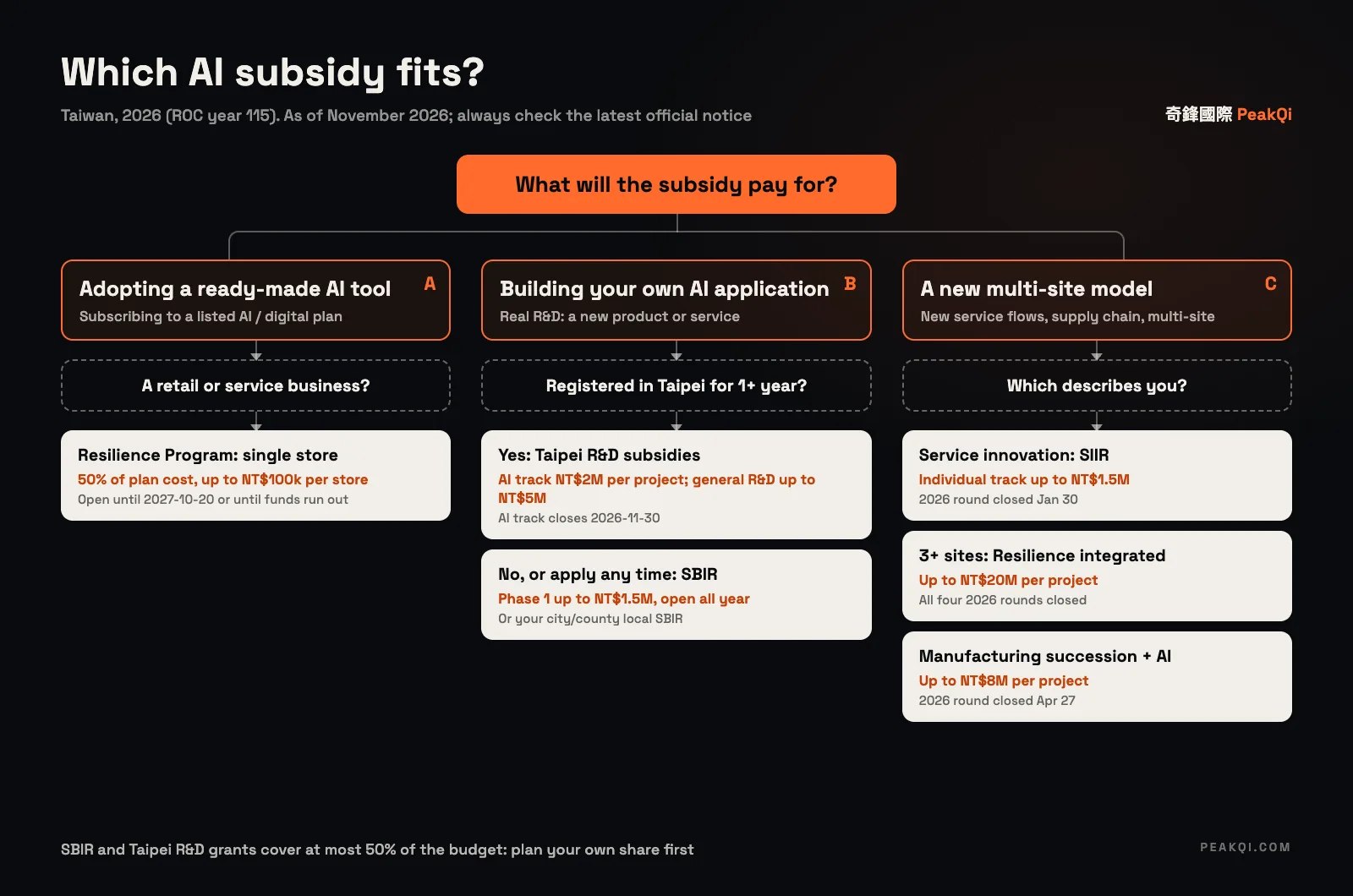
- Adopting a ready-made tool. You want to subscribe to an existing AI customer service, marketing or scheduling system. Only the Resilience Program's single-store track fits. It covers plans listed on the official Smart Transformation marketplace, requires a subscription of at least six months, and pays out after three months of actual use. SBIR and Taipei's grants fund R&D, and buying software alone usually falls outside their scope.
- Doing your own R&D. You want to build an AI application that doesn't exist yet, such as turning your in-house expertise into an AI system. If you are registered in Taipei and at least one year old, compare Taipei's AI track (rounds) with its general innovation R&D grant (rolling). Elsewhere, or if you want to apply at any time, look at SBIR and your local SBIR.
- A new model across stores or sites. Service businesses designing new service flows should watch SIIR. Projects integrating three or more sites with supply-chain partners fit the Resilience Program's integrated track. Manufacturers combining succession with AI should watch the Industrial Development Administration's program. All three closed for 2026, so this is the time to settle your topic and partners.
If you haven't sized the project yet, start with what AI automation costs a small business and how long it takes, then compare your estimate with the subsidy caps.
SBIR and local SBIR: the main door for AI R&D
For SMEs that want to fund AI R&D, SBIR is usually the first program to look at: it is open all year and not limited to any industry. According to the SBIR website, caps rose on January 1, 2026: Phase 1 (feasibility) up to NT$1.5 million over six months; Phase 2 (R&D) up to NT$12 million over two years for a single company, no more than NT$6 million a year; Phase 2+ (value-added application) up to NT$6 million. The grant cannot exceed 50% of the total budget, so the company funds at least half.
Applicants must be legally registered SMEs (paid-in capital of NT$100 million or less, or fewer than 200 regular employees), with no mainland Chinese investment, not a branch office, no unpaid taxes in the past three years, and no other subsidy for the same project. For 2026, Phase 1 applications use a slide-deck format (Annex B in the SBIR download area) rather than a full written proposal.
Local SBIR programs are run by city and county governments. Caps are lower, but you only compete with companies from the same area. Taichung's 2026 round, for example, offered up to NT$1 million for a single applicant and NT$2 million for two joint applicants, with paper submissions from May 25 to June 26. Each city sets its own schedule.
Taipei does not run a local SBIR. Its equivalent is the Taipei Industrial Development Incentive and Subsidy Program, whose second thematic R&D round for 2026 is "AI Innovation Applications": NT$2 million per project, a total budget of at least NT$4 million, about 15 awards, a project period from December 1, 2026 to November 30, 2027, and online applications until November 30.
Service sector digital transformation subsidies: Resilience Program and SIIR
The Commerce Development Administration's Resilience Program is the main 2026 vehicle for service-sector digital transformation. It has single-store, multi-store and integrated tracks.
- Single store: for retail and service businesses affected by global trade conditions. Stores choose a plan listed on the Smart Transformation marketplace; the grant covers 50% of the plan cost, up to NT$100,000 per store, once per store, until October 20, 2027 or until funds run out. This has the lowest barrier to entry.
- Integrated: grant capped at 50% of the budget and NT$20 million per project, and your own share cannot exceed paid-in capital. The smart-operations track requires at least three sites and at least 200 participating partner businesses. Four rounds ran in 2026; the last closed October 30.
- Multi-store: the first 2026 round closed March 31; check the official guidelines for caps.
SIIR funds new service models. In 2026, caps were NT$1.5 million for individual projects, NT$5 million for collaborative projects (at least three companies) and NT$5 million to NT$10 million for international projects, with higher caps for sports services. There was only one 2026 round, closing January 30.
What to prepare before applying
Most R&D grants ask for the same core documents. Start about a month before the deadline:
- Eligibility documents: company registration, founding date (Taipei requires one year), and the latest labor insurance headcount (SBIR uses it to confirm SME status).
- Financials: audited statements or the business income tax return. The Industrial Development Administration program also requires positive net worth and a bank credit report.
- Tax clearance: certificates from both the National Taxation Bureau and the local tax office. They are separate documents.
- Business certificate (MOEACA card): most programs are online-only and verify you with it.
- Proposal in the official format: every program has its own template; don't reuse another program's proposal.
- Budget table: the subsidy share must be consistent across line items; personnel costs are generally capped at 60% of the budget, and R&D staff must be full-time employees insured through the company.
- Partner agreements: if you outsource development or hire advisors, attach the contract or a letter of intent.
A clear scope makes a better proposal. Our method lays out the steps from validating one workflow to full launch, which maps well onto a proposal's execution plan.
Common reasons applications fail
Rejections usually fall into four groups: eligibility, documents, budget and content. The examples below come from official briefing materials and published review decisions.
| Type | Common problem | How to avoid it |
|---|---|---|
| Eligibility | Company under one year old, branch office, mainland Chinese investment, same project already subsidized | Check every eligibility and exclusion clause before you start |
| Documents | Only one of the two tax clearance certificates; staff insured through a union instead of the company | Use a checklist; even a one-person company can insure an employee through the company |
| Budget | Grant larger than own share; inconsistent subsidy ratios across line items; marketing costs in an R&D project | Keep every line item at the same subsidy ratio; leave non-R&D costs out |
| Content | Unfocused proposal and answers, weak market research, vague product specs | Write what you'll build, for whom, and how it differs from what exists, as testable specs |
Content problems are the hardest to fix. A published Taipei appeal decision on a 2025 innovation R&D application records that the review committee declined it because "the proposal and answers lacked focus" and "market and industry research was insufficient." SBIR also accepts no additional material after the review meeting, so everything has to be ready beforehand.
How PeakQi can help
PeakQi (奇鋒國際) builds AI systems and also helps companies apply for government AI subsidies; our core team has long experience writing and running subsidized projects. We help in three ways: assessing which program fits your industry, location and scope; turning your AI adoption plan into a proposal reviewers can follow, believe and verify; and, once funded, building and launching the system.
A subsidy is only one source of funding, and the project has to stand on its own. For choosing a vendor, see how to choose an AI automation partner in Taiwan; for costs, see pricing. If you want to talk through which subsidy fits your situation, let's find a time to talk.
Frequently asked questions
Q: Can I get a subsidy for buying an AI tool or SaaS subscription? Look at the Resilience Program's single-store track. It covers 50% of a listed plan, up to NT$100,000 per store, for retail and service businesses that subscribe for at least six months, paid after three months of use. SBIR and Taipei's R&D grants fund R&D, so buying a tool alone usually doesn't qualify.
Q: Can one AI project receive two subsidies? No. SBIR and similar R&D programs exclude projects that already receive another subsidy for the same work. Different projects can each apply, but you need to explain how they differ; the Industrial Development Administration's guidelines explicitly allow a statement of differences from other government projects.
Q: Can a newly founded company apply? It depends. Taipei's program requires at least one year since registration. SBIR's published eligibility rules have no minimum age, but you must meet the SME definition and fund at least half the budget yourself, so check your cash position first.
Q: When will the 2027 programs be announced? Watch each agency's notices. Based on 2026: SIIR was announced in December 2025 and closed in January; the Resilience Program's integrated track opened its first round on February 13; SBIR runs all year. If you are aiming for an early-2027 round, start preparing now.
By the PeakQi team. Subsidy details are compiled from official websites and notices of the Taipei City Department of Economic Development, the MOEA Small and Medium Enterprise and Startup Administration, the MOEA Commerce Development Administration, the MOEA Industrial Development Administration and the Taichung City Economic Development Bureau, current as of November 2026. Programs change every year; always check the latest official notice before applying. Published 2026-11-14.