GEO (Generative Engine Optimization) is the practice of getting AI search tools such as ChatGPT, Gemini, Perplexity and Google's AI Overviews to cite your website and mention your company when they answer a question. It does not replace SEO. Most AI search first pulls pages from a search index, then picks the passages worth quoting, so GEO builds on SEO and adds one more requirement: content that AI can reach, understand and confidently quote. In practice that means answering up front, backing numbers with sources, adding an FAQ, publishing structured data and an llms.txt file, being clear about who you are and what you have done, and earning mentions on other sites. Results can be tracked with GA4's "AI Assistant" channel and Google Search Console.
What is GEO? A research term from 2023
The term comes from the paper "GEO: Generative Engine Optimization" by Pranjal Aggarwal and colleagues, first posted in November 2023 and accepted to KDD 2024 (arXiv 2311.09735). The authors built GEO-bench, a benchmark of 10,000 queries, and tested nine ways of rewriting web content to see which made it appear more often, and earlier, in AI-generated answers.
The findings most useful to a business:
- Citing sources, adding quotations and adding statistics worked best, improving position-adjusted word count by 30–40% and a subjective impression score by 15–30% over the unmodified text.
- Keyword stuffing did not help. It scored 17.8 against a baseline of 19.5, and on Perplexity it performed about 10% worse than the original.
- Smaller sites gained the most. A source ranked fifth in search results saw a 115.1% visibility gain after adding citations, while the top-ranked source dropped 30.3%.
These are lab results, not a forecast for your site. The direction is still clear: AI favours content that is grounded and quotable, not keyword density.
How is GEO different from SEO?
SEO competes for a high ranking and a click. GEO competes to be written into the AI's answer and listed as a source. Same website, same content; what changes is who reads it and how.
| SEO (Search Engine Optimization) | GEO (Generative Engine Optimization) | |
|---|---|---|
| Goal | Rank high in results and earn the click | Be cited in the AI answer, named, and linked as a source |
| Reader | A person scanning a results page | An AI that reads first and summarises; the person may never click |
| Unit of content | The whole page | A paragraph, a table, a single Q&A |
| What helps | Keywords, titles, internal links, page speed | A direct opening answer, sourced numbers, FAQs, comparison tables |
| Trust signals | Backlinks, domain authority | Authorship, track record, third-party mentions, consistent facts |
| Measurement | Search Console rankings and clicks | GA4 AI Assistant channel, AI referral URLs, Search Console |
| Shared prerequisite | Pages must be crawlable and indexed | Same; a blocked page is invisible to AI too |
The last row matters most. Google's own documentation says a page only needs to be "indexed and eligible to be shown in Google Search with a snippet" to appear as a supporting link in AI Overviews or AI Mode, with no additional technical requirements (Google Search Central: AI features and your website). Without solid SEO, GEO has nothing to stand on.
How do ChatGPT, Gemini, Perplexity and Google AI Overviews choose sources?
None of them publish their ranking details, but their official documentation outlines a shared pattern: retrieve, select passages, then generate an answer with sources.
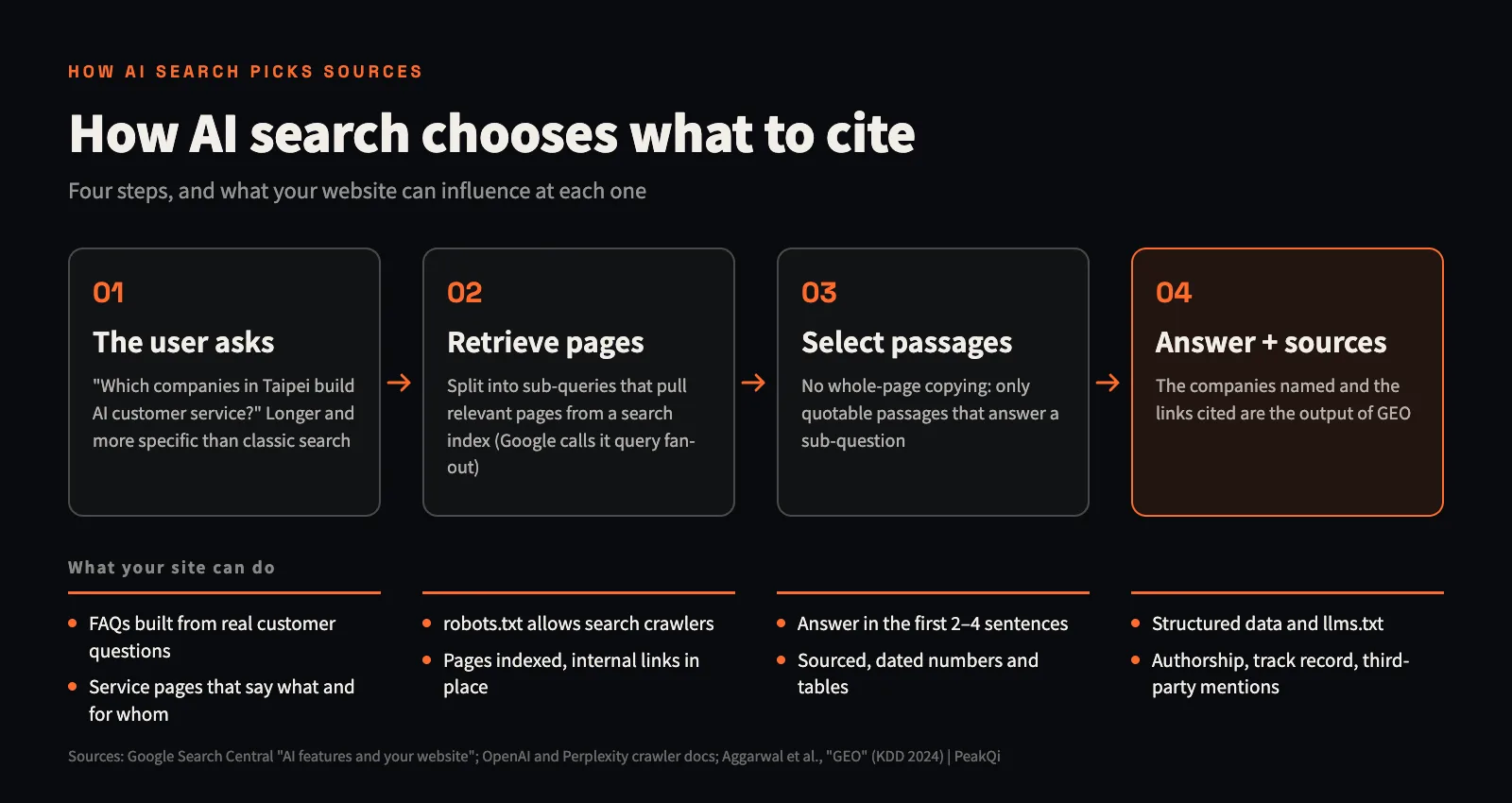
- The user asks. For example, "Which companies in Taipei build AI customer service?" AI queries tend to be longer and more specific than classic searches.
- Retrieval. Google's AI Overviews and AI Mode may use "query fan-out", issuing several related searches at once (same Google document). ChatGPT search relies on OAI-SearchBot, and OpenAI states that sites opted out of it will not be shown in ChatGPT search answers (OpenAI crawlers). Perplexity recommends allowing PerplexityBot in robots.txt (Perplexity crawlers). This step runs on classic criteria: crawlable, indexed, relevant.
- Passage selection. AI does not copy whole pages. It picks the passages that answer each sub-question. Paragraphs that lead with the conclusion and carry numbers, sources or a clear Q&A are easier to pick, which is exactly what the GEO paper measured.
- Answer with sources. The companies named and the links cited are the output of GEO. Only the people who click through show up in your analytics.
Seven things a business website can do
Ordered from lowest effort to slowest payoff. The prerequisite: your site is crawlable and indexed, and neither robots.txt nor your CDN or firewall blocks search crawlers such as OAI-SearchBot and PerplexityBot.
1. Open every page with a clear answer
Whatever the title asks, answer it in the first two to four sentences. On a service page, say what you do, for whom, and how long it takes to go live. This is the paragraph AI quotes most.
2. Add an FAQ
Write the questions customers actually ask as short Q&As, each answer understandable on its own. It is the easiest format for AI to lift into an answer.
3. Give every number a source and a year
"Live in as little as 10 working days" is more quotable than "fast onboarding". Figures from government, research or official documents need a link and a date. All three of the best methods in the GEO paper come down to being grounded.
4. Structured data (Schema.org)
Mark up your company (Organization), articles (Article / BlogPosting) and FAQs (FAQPage) in JSON-LD. Google says AI features need no special structured data, but asks that markup match the visible text. Its value is making "who this company is" unambiguous.
5. Publish an llms.txt file
llms.txt is a format proposed by Jeremy Howard in September 2024: a Markdown file at your site root with a title, a short summary and a list of links that tells AI agents what the site contains (llmstxt.org). To be clear, Google says you don't need to create new AI text files to appear in its AI features, so treat llms.txt as a cheap supplement, not the main event.
6. Make authorship and track record explicit
Who wrote it, what the company has delivered, which awards it has won, where it is registered. Keep your legal name, English name and registration number identical across the site so AI does not confuse you with a similarly named business.
7. Earn third-party mentions
When AI answers "who should I hire", it weighs what others say about you, not just what you say: press coverage, award announcements from governments or organisers, industry directories, partner pages, your Google Business Profile. This is the slowest lever and the hardest to copy.
What the PeakQi website actually does
PeakQi's own site, the one you are reading, is built this way today. Here is only what is actually on the site and can be checked by anyone:
- llms.txt: /llms.txt describes the company, services, products, case studies and every article in Chinese and English, regenerates automatically when a post is added, and notes that we are unrelated to other businesses using the name 奇鋒.
- Structured data: one company entity for the whole site, with Chinese and English names, registration number, founding date and address; every post is marked up as BlogPosting with author and publisher pointing to that entity.
- FAQ to schema: the FAQ at the end of each post is turned into FAQPage markup at build time, this one included.
- Bilingual: every post has a Chinese and an English version, linked with hreflang.
- Crawler access: robots.txt explicitly allows OAI-SearchBot (ChatGPT search) and ChatGPT-User (user-initiated fetches).
- Pre-publish check: every post is checked for an opening answer, FAQ, figures, a comparison table, external sources and internal links before it goes live.
How one person built the site is told in I hadn't written code in ten years. I built a website with Claude Code. If you want the same method in your own content pipeline, AI Marketing Pro is our GEO/SEO workbench that runs from keyword research through drafting and checks to publishing.
How do you measure GEO?
There are two layers: whether you are cited or mentioned, and whether anyone clicks through. The second has ready-made tools.
- GA4's "AI Assistant" channel. GA4's default channel group now includes AI Assistant, which automatically groups visits from known AI assistants such as ChatGPT, Gemini and Copilot. Google's documentation notes it excludes Google's own AI Overviews and AI Mode (Google Analytics Help: default channel group).
- ChatGPT's UTM tag. OpenAI says ChatGPT search automatically adds
utm_source=chatgpt.comto referral links, so those sessions show up by source in GA4 (OpenAI publishers FAQ). - Search Console. Clicks from AI Overviews and AI Mode are counted under the "Web" search type in the Performance report, combined with regular search; they can't currently be separated.
- Manual spot checks. Each month, ask ChatGPT, Gemini and Perplexity the same 10–20 questions your customers ask, and record whether you are mentioned and which page is cited. It is still the most direct way to track mentions.
Bear in mind that an AI answer may already cover the essentials, so people may not click. Beyond traffic, watch how many enquiries and LINE follows say they found you through AI; a "How did you hear about us?" option on your contact form is enough to start.
Five common myths
Myth 1: GEO replaces SEO. Google's guidance for AI features is SEO fundamentals: allow crawling, link internally, offer a good page experience, keep important content in text. GEO sits on top.
Myth 2: An llms.txt file gets you recommended. Google says its AI features need no extra AI text files. llms.txt is worth adding because it is cheap, but it will not move results on its own.
Myth 3: There is a special schema for AI Overviews. Google says there isn't. Structured data keeps your facts consistent and unambiguous; that's its job.
Myth 4: More keywords help. In the GEO paper's tests, keyword stuffing did worse than the original text.
Myth 5: You can pay to be recommended by ChatGPT. There is no official way to make organic AI answers name a particular company. If a service guarantees rankings or AI recommendations, ask exactly how they do it. What you can do is make your content easier to cite and keep tracking it.
Want to know how your site shows up in AI search today, and which page to fix first? Let's set up a time to talk. The full scope of our AI adoption work is on Solutions.
Frequently asked questions
Q: What is GEO, and is it the same as AEO? GEO is the practice of getting generative AI such as ChatGPT, Gemini, Perplexity and Google AI Overviews to cite your content in their answers. AEO (Answer Engine Optimization) is a closely related term that also focuses on writing content that directly answers questions; in practice the two overlap almost entirely.
Q: How can a small business get ChatGPT to recommend it? First make sure your site does not block OAI-SearchBot and is properly indexed. Then open your service pages with a clear answer, add FAQs, sourced numbers and your track record, and work on third-party mentions such as press, award announcements and partner pages. There is no single fix; it is ongoing work.
Q: Do I need an llms.txt file? It isn't required. Google says its AI features need no additional AI text files; llms.txt is a 2024 community proposal that some AI agents read. It costs almost nothing, just one Markdown file, so it's a reasonable supplement, but don't treat it as the main task.
Q: How long until GEO shows results? There is no fixed timeline. After you update your site, search engines need to recrawl and reindex it before AI search can see the changes, and third-party mentions take longer to build. Spot-check the same set of questions monthly and give it at least three months before judging direction.
Written by the PeakQi team. GEO research figures are from Aggarwal et al., "GEO: Generative Engine Optimization" (KDD 2024). Google, OpenAI and Perplexity practices are as described in their official documentation as of November 2026. The website practices described are this site's actual configuration. Published 2026-11-14.