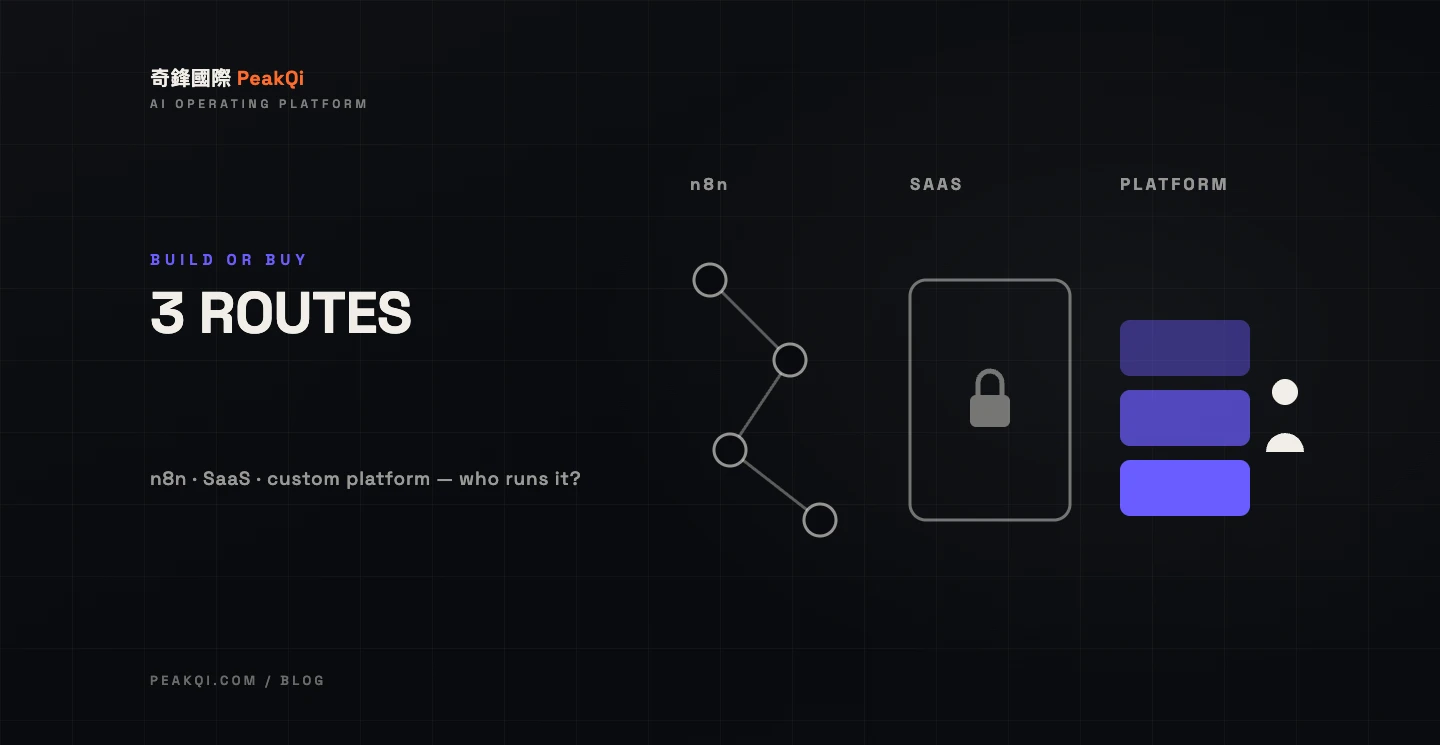
Short answer: there are three routes to putting AI into an operational process — (1) a workflow tool like n8n: you wire LINE, forms, AI and spreadsheets together yourself with nodes; flexible and cheap to start, but when the flow breaks, you fix it; (2) packaged SaaS: buy a ready-made tool for one clearly defined task; fastest to start, but data between tools still moves by hand, and you can only change what the vendor exposes; (3) a custom AI platform: a vendor builds, integrates and operates it around your process, including human handoff and post-launch tuning; highest upfront commitment, but "who fixes it" and "who changes it" have a clear owner. All three are legitimate. The deciding factor isn't the feature list — it's whether you have someone to maintain it long-term and whether the process is still changing.
First, what each route actually is
The three get compared as if they were the same kind of thing. They answer different questions:
- n8n (and Zapier, Make and their kind): a workflow automation tool. You drag nodes on a canvas: "LINE receives a message → send it to an AI model → write the result to a spreadsheet → notify sales." n8n can be self-hosted or cloud, it's open source, has many nodes and a large community. What it gives you is building blocks. How the flow is assembled and what happens when it fails is up to you.
- Packaged SaaS: a finished product — a particular AI support tool, a particular scheduling tool. Subscribe, configure, go live, usually within a day. What it gives you is a furnished room: the layout is fixed, you can move the furniture.
- A custom AI platform: a system built and operated around your process. In PeakQi's case, modules on one back office (intake, CRM, quoting, content) combined for the stage you're stuck on, integrated with your existing LINE, forms and CRM, with human handoff and post-launch calibration included. What it gives you is one process with an owner.
So the real question isn't "which has more features." It's: once this process is live, who is responsible for keeping it working?
One table: compared from an operations point of view
| n8n (self-assembled) | Packaged SaaS | Custom AI platform | |
|---|---|---|---|
| Who assembles the flow | You (someone who thinks in logic) | Vendor built it, you configure | Vendor builds it around your process |
| Who fixes it when it breaks | You — including the 3 a.m. API change | Vendor fixes the product; your integrations are yours | Vendor, as part of operations |
| Where the data lives | Self-hosted: with you; cloud: with n8n | Vendor's servers; export depends on the plan | Per contract — confirm separate storage and export before signing |
| Who changes the process | You, immediately | Only within settings the vendor exposes | Request to vendor, scheduled by scope |
| When the AI can't decide | You design the handoff node yourself — often skipped | Depends on the product | Explicit handoff rules with the conversation summary attached — a deliverable |
| Connecting existing LINE / CRM | Many nodes, most things connect; details are yours | Often only its own ecosystem or popular tools | In scope; existing tools stay |
| Shape of the cost | Software cheap or free; people are the main cost | Monthly subscription, predictable | Setup + monthly + usage |
| Team it suits | At least one person who can maintain automation | One clearly defined task | Steady enquiry volume, process spans tools, no internal maintainer |
The row most often underestimated is the second one. n8n's software cost really is low, but maintaining a live flow is an ongoing people cost: an upstream API changes, the AI model's response format shifts, a node times out — none of that appears on a quote, all of it appears in someone's overtime.
Decision flow: four questions, in order
- Do you have someone who can maintain automation long-term? Not "can they drag nodes" — "if they leave, does someone take over?" Yes → n8n is a strong choice. No → skip it, or in three months you'll have a broken flow nobody dares touch.
- Are you solving one task, or one process? One task (say, "auto-answer common questions") → packaged SaaS is usually the best value. One process (catch the enquiry → organise it into a record → schedule follow-up → hand off to a human) → a single tool won't cover it; choose between n8n and a custom platform.
- Has the process settled? Still changing weekly → n8n lets you adjust it yourself, fast. Stable, just no one to do it → a custom platform takes it over.
- When the AI can't decide, who catches it? This needs an answer on all three routes. On n8n you draw the handoff node yourself; on SaaS it depends on the product; on a custom platform it's a deliverable. A plan with no answer to this shouldn't go live.
Ask all four and the answer usually falls out — and it's often not "pick one of three." See the next section.
Who each suits, and the common combination
- n8n suits: teams with an engineer or a logic-minded ops person, processes still iterating, wanting to validate an idea cheaply. Doesn't suit: no maintainer, or customer-facing conversations with no handoff designed.
- Packaged SaaS suits: a single clear task, a budget that must be predictable, no appetite for anything technical. Doesn't suit: data that has to travel between several tools — that unowned gap is exactly where customers leak.
- A custom AI platform suits: enquiries concentrated in LINE / forms, steady volume, a process spanning several tools, no internal maintainer, and a need for human review points. Doesn't suit: very low enquiry volume, or a process that hasn't settled (use n8n or SaaS to learn it first).
The combination we see most: the core process (intake → CRM → follow-up) on a custom platform, because when that breaks it hits revenue directly and someone has to own it; peripheral internal automations (reports, notifications, data sync) on n8n, because a failure there is low-impact and quick to fix. The two don't conflict.
Risks and limits
- n8n's hidden cost is people. Self-hosting means looking after a server and updates; cloud means watching the usage plan. More importantly, when "the one person who changes it" leaves, the flow becomes a black box nobody dares touch. Before launch, make sure a second person can read it.
- SaaS's risk is the boundary. You can only change what the vendor exposes; ask about export formats and deadlines before signing.
- A custom platform's risk is dependency. If the vendor folds or the relationship ends, what happens to the system — confirm separate data storage, exportability and exit terms in the contract. The full checklist is in how to choose an AI automation partner.
- None of the three "works once installed." The knowledge base is yours to organise, the stages are yours to define, and the first weeks after launch need calibration against real conversations. The tool changes; that work doesn't disappear.
Common questions
Q: We already have some flows on n8n. Do we still need a custom platform? Not necessarily. If those flows have a maintainer, customer conversations have a handoff, and the CRM data is complete, keep going. Teams usually reconsider in three situations: the maintainer is leaving, a flow starts touching customer conversations without a review step, or the CRM keeps ending up empty (see AI CRM vs traditional CRM).
Q: Is a custom platform the same as "building from scratch"? Not the way PeakQi does it. Existing modules are combined around your process and connected to your existing tools; a full bespoke build is a different scale of project. The difference and the cost structure are in the full cost breakdown.
Q: Can we validate with SaaS or n8n first and switch later? Yes, and we recommend it. Use the cheap route to confirm "automating this stage is actually worth it," then decide whether to invest in a fuller build. The thing to watch is data portability: put customer data somewhere exportable from day one, so switching doesn't mean starting over.
Q: n8n can call AI models too — why have someone else build it? Connecting and running reliably are two different things. Calling an AI is step one; extracting fields, handing off when it can't decide, carrying the conversation summary across, scheduling follow-up by stage — on n8n, each of those is yours to design and test. Doable, but it needs a person to do it and a person to maintain it. Connecting LINE AI support to your CRM breaks down what each of those four links involves.
Q: A real example? Real estate: LINE enquiries caught by AI, viewings scheduled, customer status written to the list, with human handoff (full case study). How we deliver — six stages, three risk-reduction mechanisms — is on how we deliver.
Written by the PeakQi team. The comparison dimensions come from the questions we actually get asked during evaluation. For n8n and individual SaaS products, their own documentation is the authority; this article quotes no prices. PeakQi offers the custom-platform route — when evaluating, go by the four questions here, not by the name. Published 2026-09-24.